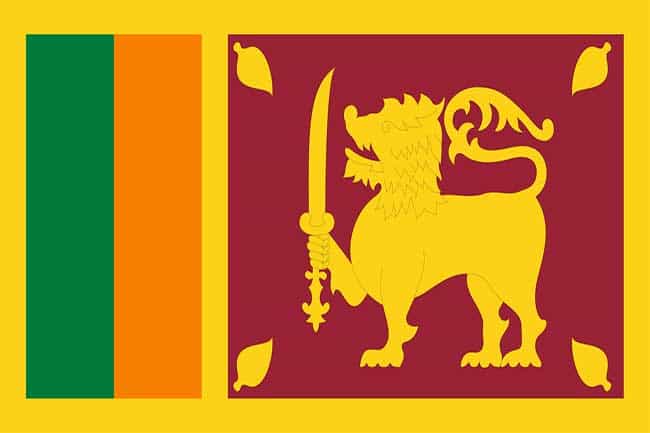
Sri Lanka – General information
Sri Lanka – General Information
Area: 65,610 km²
Population: around 22–23.3 million (as of 2026, depending on the source/counting method; figures fluctuate as there has been noticeable emigration since the 2022 economic crisis – according to estimates, well over 1 million Sri Lankans now work abroad, an important economic factor through remittances).
Population density: around 335–370 inhabitants per km².
Capital: Sri Jayawardenepura Kotte (official seat of government, suburb of Colombo, approx. 115,000–130,000 inhabitants). Colombo (de facto capital, economic and administrative centre): approx. 650,000 inhabitants in the urban area, but several million people in the greater Colombo area (metropolitan area).
Geography: The island of Sri Lanka is located in the Indian Ocean off the coast of the Indian state of Tamil Nadu, separated by the Palk Strait or the offshore island chain Adam’s Bridge. The landscape is unusually diverse: low-lying coastal plains in the north and west, while the central and southern parts of the country rise to hills and mountains. The highest elevation is Pidurutalagala at 2,524 m.
Form of government: Presidential republic in the Commonwealth (since 1978), constitution of 1978 with several subsequent amendments. Unicameral parliament with 225 deputies. Current head of state (president): Anura Kumara Dissanayake, in office since September 2024. Current Prime Minister: Harini Amarasuriya, in office since September 2024. Independent since 1948 (former British colony, then “Ceylon”).
Political background: Sri Lanka experienced a severe economic and state crisis in 2022 (insolvency, massive protests, resignation of then-President Gotabaya Rajapaksa). The reform and austerity programmes initiated since then with the International Monetary Fund (IMF) and the left-wing President Dissanayake, who has been in office since 2024, have led to a certain political and economic stabilisation, even if observers believe that reform implementation remains sluggish. For travellers, the tourist infrastructure has largely returned to normal since the crisis.
Language: The official languages are Sinhala (Sinhala, approx. 74% speakers) and Tamil (approx. 14–18%). English serves as the language of trade and education and is widely understood, especially in cities and in the tourism sector.
Religion: Buddhism (approx. 70%, state religion with special constitutional status); Hinduism (approx. 12–15%), Christianity (approx. 7–8%) and Islam (approx. 9–10%) as significant minorities.
Local time: Sri Lanka Standard Time (SLST), year-round UTC +5:30 (no daylight saving time). Compared to Central Europe (CET), this corresponds to +4:30 hours, compared to CEST +3:30 hours.
Mains voltage: 230/240 V, 50 Hz. Several types of plugs are common in Sri Lanka (including Type D and Type G, three-pin circular plugs); a universal travel adapter is strongly recommended.
Phone: International direct dialing is readily available nationwide. Country code: +94.
Mobile telephony: Prepaid SIM cards are available at Colombo Airport and in cities at a low price and easily; the largest providers today are Dialog Axiata, Mobitel (SLT-Mobitel), Hutch and Airtel Lanka. Network coverage is good in most tourist areas, but sometimes limited in remote mountain regions.
Internet: WLAN is now standard in hotels, guesthouses, cafés and restaurants in tourist centres, often free of charge; in addition, a local data SIM card is recommended for travelling.
Mail: Airmail to Europe usually takes 1–2 weeks. Post offices can be found in practically every city and town; in addition, private courier services (including DHL, FedEx) are common in the larger cities.
Currency: Sri Lankan rupee (LKR). Approximate exchange rate (fluctuates daily): 1 euro ≈ 380–390 LKR. Card payment is common in hotels, larger restaurants and shops in cities, but cash is predominantly required in rural areas and local markets.
Sri Lanka – Entry and Visa
German, Austrian and Swiss nationals cannot enter Sri Lanka without a visa . An electronic travel authorization, the ETA (Electronic Travel Authorization), is required, which must be applied for online before the start of the trip – exclusively via the official portal eta.gov.lk.
The tourist ETA usually entitles the holder to a stay of 30 days with two entries and can be extended to up to 60 days on site in Sri Lanka if necessary. There have recently been contradictory information about the fees: According to a new regulation announced in May 2026, the ETA was to become free of charge for nationals of around 40 countries – including, according to several sources, Germany, Austria and Switzerland; other, also current sources continue to mention a fee of the equivalent of around 90-100 US dollars for the DACH countries. Since this regulation is obviously still in flux, travelers should check the daily fees and conditions immediately before applying for eta.gov.lk.
Other things to note:
- The passport must be valid for at least 6 months upon entry.
- For accompanying children, a separate children’s passport and their own ETA are generally required (entry in the parents’ passport is no longer sufficient).
- Proof of onward travel (return or connecting ticket) is occasionally required.
- The use of commercial third-party websites that charge significantly higher fees than the official portal is not recommended.
Since entry requirements can change at short notice, it is also advisable to take a look at the current travel and safety advice of the Federal Foreign Office before each trip.
Sri Lanka – Food and Drink
The specialty in Sri Lanka is a simple curry dish made with coconut milk, onion slices, chillies and aromatic spices such as cloves, nutmeg, cinnamon and saffron.
Hoppers resemble half a toasted bun with a soft fried egg. Stringhoppers are steamed noodles made from rice flour, slightly thinner than spaghetti. Jaggery, a type of caramel candy made from the juice of the kitul palm, is also a popular dessert.
Drinks: The national drink is tea, which is one of the best in the world – Ceylon tea from the highland regions around Nuwara Eliya and Ella still enjoys a worldwide reputation today. Toddy (palm juice) is a popular traditional drink; when fermented, arrack is formed, which is available in different alcohol strengths. On the Poya holiday (on every full moon), no alcohol is traditionally served.
Nightlife: Some hotels in Colombo have restaurants with live music and dancing. There are also theatres, cinemas, ballet performances and concerts, especially in the capital.
Shopping tips: Objects made of silver, brass, ceramics, wood and terracotta as well as baskets made of cane, straw hats, reed mats, ebony elephants and drums are among the popular souvenirs. Ceylon tea in attractive packaging as well as handmade gemstone jewellery (Sri Lanka is known for sapphires) are also among the classic souvenirs.
Opening hours of the shops: Mon–Fri approx. 9 a.m. to 5.30 p.m., Sat usually 9 a.m. to 1 p.m.; many shops in cities and tourist centres are also open continuously on Saturday mornings and in shopping centres.
Note: All information on population figures, political offices, exchange rates and entry requirements is subject to change and has been researched to the best of our knowledge as of August 2026. For up-to-date, binding information on the ETA, it is advisable to take a look at eta.gov.lk as well as the travel and security advice of the Federal Foreign Office before travelling.
Questions about Sri Lanka
In the Asia forum you will get the answers!

Author: Joe OnTour
Autor + Reise-Blogger